Explore a production
Who Framed Roger Rabbit at Elstree
Who Framed Roger Rabbit brought live-action filmmaking and traditional animation together on an extraordinary scale. Although its story takes place in 1940s Hollywood and Toontown, much of its live-action world was created at Elstree Studios in Borehamwood.
British craftspeople built, painted and dressed enormous sets while devising physical effects that allowed actors to interact convincingly with cartoon characters who would not appear until much later. The result was one of the most technically ambitious productions made at Elstree during the 1980s.
Production at a glance
- Production
- Who Framed Roger Rabbit
- Released
- 1988
- Director
- Robert Zemeckis
- Animation director
- Richard Williams
- Production companies
- Touchstone Pictures, Amblin Entertainment and Silver Screen Partners III
- Principal studio
- Elstree Studios, Shenley Road
- Additional filming site
- White City, London
- Production designer
- Elliot Scott
Making Roger Rabbit at Elstree
Creating a believable world shared by human actors and animated characters required every department to work with unusual precision. The animation was added after the live-action photography, but the sets, props, lighting and performances all had to anticipate characters who were invisible during filming.
Scenic artist Ron Punter remembers beginning with the kitchen and living-room sets used for the opening cartoon sequence. His work soon expanded beyond scenery because the production required an extraordinary number of specially prepared props.
For the Ink and Paint Club, full-size rubber penguins were positioned around the set so that the crew could plan the shots and understand where the animated waiters would eventually appear. Ron painted the penguins before they were replaced by their animated counterparts—giving The Elstree Project’s documentary Painting Rubber Penguins its title.
Props master Barry Wilkinson recalls the vast quantity of objects required for the production. Breakaway trophies and bottles for Judge Doom’s office were made from toffee glass, while thousands of fictional products were prepared for the Acme factory sequence.
The factory interior was created inside a disused Underground railway building at White City. Crews worked day and night to repair, repaint and redress the set between filming days.
Meanwhile, Annie Elvin’s matte and roto department worked on bringing the live-action and animated elements together. Individual frames were photographed, printed and peg-registered so that travelling mattes could be carefully drawn around the actors, objects and scenery. The completed elements were later combined by Industrial Light & Magic.
Sets and stages
Scenic artist Ron Punter remembers the production occupying four stages at Elstree. His interview identifies Stage 3 as the principal stage, although it does not provide a complete stage-by-stage record.
- Stages 1–4
- Remembered by Ron Punter as being occupied by the production.
- Stage 3
- The principal stage, containing the Hollywood or Los Angeles exterior and the Ink and Paint Club.
- Stage not identified
- The alleyway leading to the Ink and Paint Club.
- White City
- The Acme factory interior, created inside a disused Underground railway building.
Ron’s account can be heard at approximately 5:02 in the interactive transcript below.
Painting Rubber Penguins
Painting Rubber Penguins: Making Who Framed Roger Rabbit is a short oral-history documentary produced by The Elstree Project. It tells the story of the production through three people who helped create its sets, props and visual effects.
- Ron Punter — Scenic Artist, Props Department
- Annie Elvin — Matte and Roto Supervisor
- Barry Wilkinson — Props Master
The documentary was first screened at the University of Hertfordshire in 2012 as part of a season celebrating films made at Elstree Studios.
Painting Rubber Penguins: Making Who Framed Roger Rabbit
Reuniting the crew
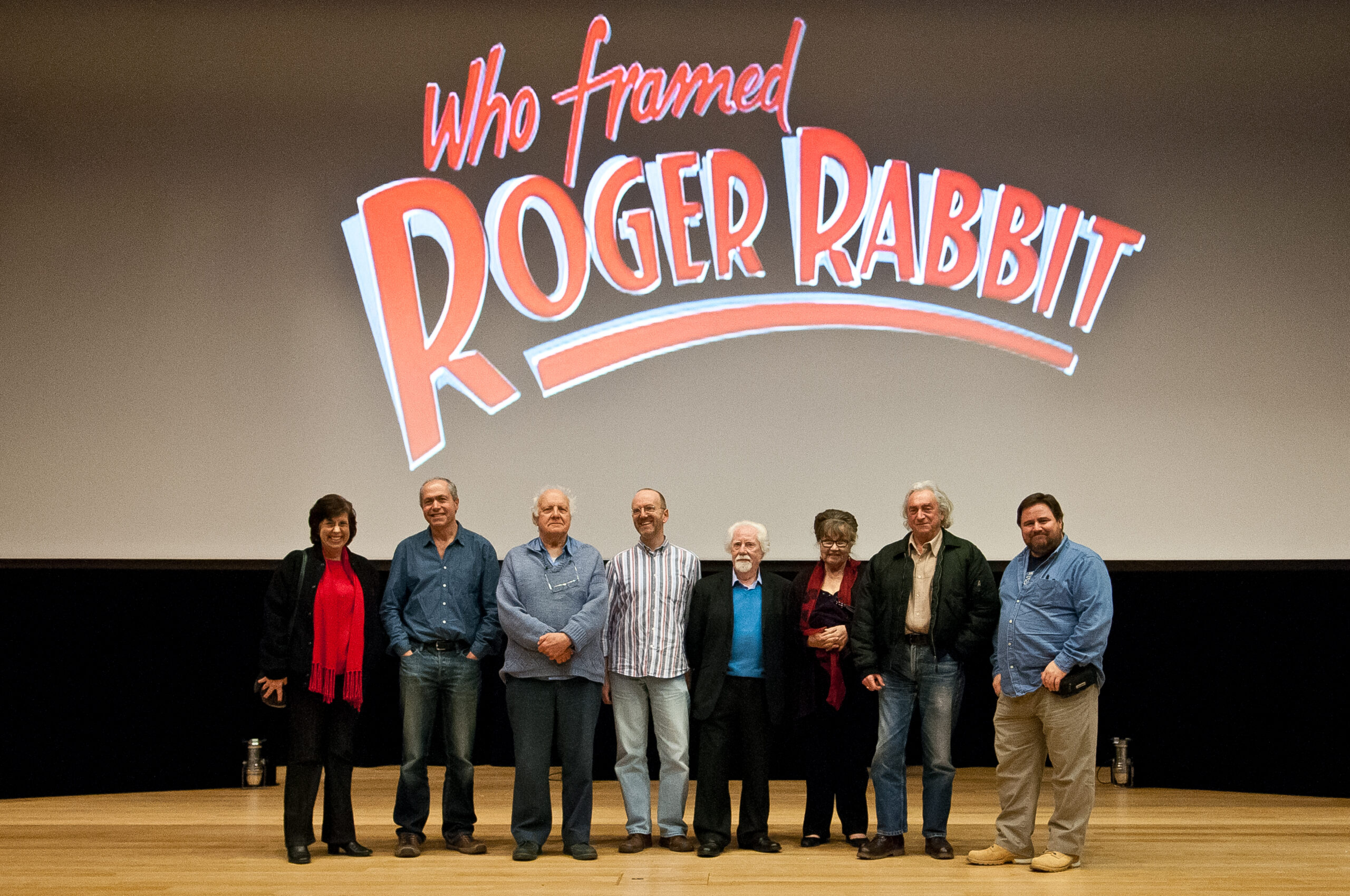
In winter 2012, The Elstree Project reunited eight members of the Who Framed Roger Rabbit crew at the University of Hertfordshire for a special screening of the film.
The group included Kevin Jon Davies, Barry Wilkinson, Ron Punter and Annie Elvin. Bringing members of different departments back together provided an opportunity to celebrate their work and hear first-hand memories of the ingenuity, craftsmanship and enormous amount of labour behind the finished film.
The people who made it
Painting Rubber Penguins preserves first-hand memories from three members of the production team whose work helped bring the live-action and animated worlds together.
Their interviews can be watched and searched in Painting Rubber Penguins above.