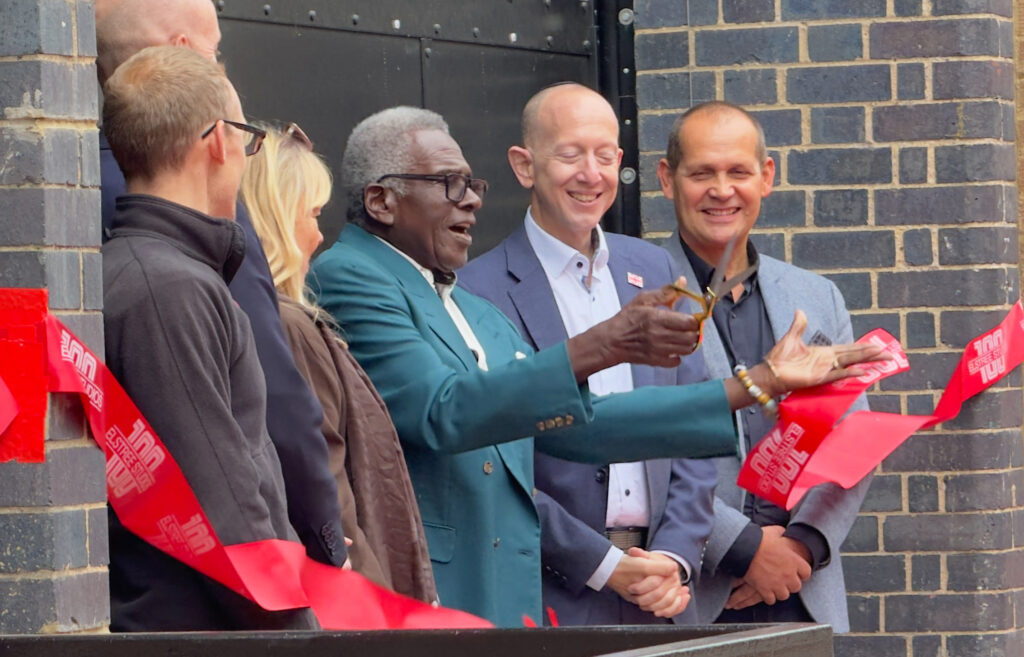
On Friday 26 September, Elstree Studios reopened Stages 7, 8 and 9 after being closed for several years due to asbestos and concrete structural issues. Rudolph Walker CBE was asked to cut the ribbon outside of Stage 7 to declare them open once more!
The Elstree Project’s director, Howard Berry, was among the invited guests and was asked to speak about the productions made on those stages. Below is a history of the stages and some of those iconic productions.
In 1966, ABPC’s Managing Director Robert Clark — a Scotsman appointed that same year — oversaw the opening of three new stages at Elstree, built at a cost of £1 million to mark the studio’s 40th anniversary.
The expansion reflected the demand for more facilities to serve the booming television market. Both The Saint and The Baron had already been pre-sold in colour to America, and ABPC invested heavily to bring The Avengers into colour production as well. It was the last major British series to make the transition from black and white before being exported to the US.
The new stages were accompanied by an underground car park, an ancillary block, and a new restaurant and office building. They were built on the site of a former car park and a row of domed sheds — once used as scene docks and timber stores — which can even be glimpsed in the 1962 crime caper Go To Blazes, featuring Robert Morley and Maggie Smith.
According to Kinematograph Weekly, the stages officially opened in October 1966. The first production to make use of them was The Champions, an espionage sci-fi drama from Lew Grade’s ITC Entertainment. Around the same time, Stage 9 hosted one of the most memorable moments in British television history: Diana Rigg’s final scene as Emma Peel in The Avengers, filmed in 1968, where she meets her successor Linda Thorson as Tara King. That same year Elstree unveiled its innovative “Add-A-Vision” system — a breakthrough that allowed the 35mm film camera’s viewfinder to be monitored on television screens around the set, a clear precursor to today’s on-set video village.
In the decades that followed, these stages housed some of the most iconic sets in film history:
- Stage 7: the Ranger Station in The Shining, the riddle-loving guards in Labyrinth, and the pioneering blue-screen shoot for Sky Captain and the World of Tomorrow.
- Stage 8: the Millennium Falcon cockpit and Jabba’s Throne Room from Star Wars, Ming’s Rocket from Flash Gordon, and the mirrored throne room in Return to Oz.
- Stage 9: the Overlook Hotel caretaker’s apartment in The Shining, Yoda’s hut in The Empire Strikes Back, the insect-filled tunnels in Indiana Jones and the Temple of Doom, Diana Rigg’s London office in The Great Muppet Caper, and the pub robot fight scenes from Edgar Wright’s The World’s End.
Television also played an increasingly important role. Over the years, the stages became home to Who Wants to Be a Millionaire?, The Chase, Pointless, Never Mind the Buzzcocks, and A League of Their Own.
In 2012, BBC Studios and Post Production — now BBC Studioworks — took a temporary lease on Stages 8 and 9 while Television Centre in London underwent redevelopment. That “temporary” arrangement was extended first to 2017, then to 2024, and now until March 2029 — with EastEnders sets currently moving into place.
First opened for Elstree’s 40th anniversary, the stages are now re-opening in time for the studio’s centenary. Recent reports had claimed the buildings were beyond saving — described as “crumbling”, “life-expired”, and even (erroneously) “100 years old” — but their restoration proves otherwise. Congratulations must go to Rebecca and all the team for spearheading this rescue, ensuring these historic stages remain central to Elstree’s story for many years to come.