
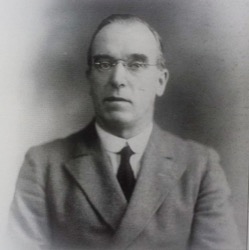
Today marks the 99th anniversary of John Maxwell joining Wardour Films and becoming chairman of the board — a move that effectively handed him control of British National Pictures and its principal asset: Elstree Studios.
Maxwell was originally brought in as an intermediary between the company’s founders, J. D. Williams and Isidore Schlesinger, at a moment when internal tensions needed steadying. In practice, however, he didn’t just broker peace — he ultimately replaced them both, and led the studio for the next thirteen years.

A hard-headed businessman from Glasgow, Maxwell introduced a famously frugal approach to studio management. Under his leadership, Elstree acquired the affectionate (and slightly barbed) nickname “The Porridge Factory” — a nod both to his Scottish roots and to the tightly controlled budgets that became the studio’s hallmark.
That discipline helped stabilise the operation, but it also defined Elstree’s culture for decades: efficient, tightly scheduled, and run very much as an industrial enterprise; in contrast to some of the methods used by his predecessors, and Herbert Wilcox.
When Maxwell died in 1940, his 50% shareholding passed to his widow, Catherine. What followed was a public bidding war, played out in newspaper headlines, as major interests vied for influence over one of Britain’s most important studios. Eventually, Warner Bros. acquired a 25% stake — an early and important moment in Elstree’s long transatlantic relationship with Hollywood. Warner Bros’ investment in the studio also included a £1 million (£38 million today) refurbishment of the studio, modernising it and securing its legacy for the next decade.

Maxwell’s name still lives on at the studios today. The John Maxwell Building forms part of Elstree’s production village, housing a range of independent companies — including the Hertfordshire Film Office.

And finally, a small historical bit of trivia: during Maxwell’s tenure he appointed a man named Arthur Dent as Head of Studios at Elstree. Decades later, the film adaptation of The Hitchhiker’s Guide to the Galaxy would be made here too — featuring another, rather more famous Arthur Dent.
History, as ever, has a sense of humour.